Is the Electoral College Still Necessary? Lets Look At Both Sides.
Well, this is an interesting development. Some might call it a conundrum. Both sides, while diametrically opposed in their viewpoints, offer similar explanations when the question for this page is presented. "Is the Electoral College still necessary?" They just don't agree if the original reasoning is valid anymore.
Their passionate answers, their emotional infusion, their deep-seated belief in the validity of their respective opinions are laudable. As are their respective reasoning and points of emphasis. In this page, we'll present the reasoning used by the founding leaders as they established the Electoral College.
They used a unique tool of governing, one that has sadly gone by the wayside. Maybe we should write about whether or not compromise is still necessary as it has been shelved over the years in Congress. For it was compromise that brought about the concept of the Electoral College in the first place.
We'll also provide links to both sides of this debate. Both are well-written and astutely researched. But in our editorial room, we wonder if maybe this debate about wondering if the electoral college is still necessary or not is really about chasing symptoms, rather than curing the underlying issue?
In a website dedicated to promoting personal accountability and responsible citizenship, we can't lose sight of our own duties as American citizens.
Creating The Electoral College
There was a concern that was never far from the forefront as the Framers drafted the Constitution, which would include the Bill of Rights. In fact this was a driving point in that important document. The Bill of Rights was all about avoiding the majority trampling the individual rights of the minority.
That same cautionary tale guided their compromise in establishing the Electoral College. Those Founding Fathers came from different sections of this fledgling federation. Some represented what was then the bustling economic centers. Those areas also tended to have higher populations.
Others trekked in from outlying areas that were either attempting to grow crops or were still trying to just survive in rural areas with far fewer settlers.
All of the men present wanted what was best for their particular section of the federation. Federation was the key word. They envisioned an ever-growing nation that would be united and governed by a strong national system, while still offering individual states the opportunity to run things that would best serve their unique areas. To do this would require compromise. Everyone gives a little for the greater good.
Compromise shaped the creation of the Electoral College. The Framers envisioned the people electing the person who would serve as the chief executive. They agreed after much discussion that without guardrails, the majority could eliminate any input from the minority segment of the voting electorate if future elections were slanted in favor of larger population centers, thereby cutting out the voices of the rest of this new nation.
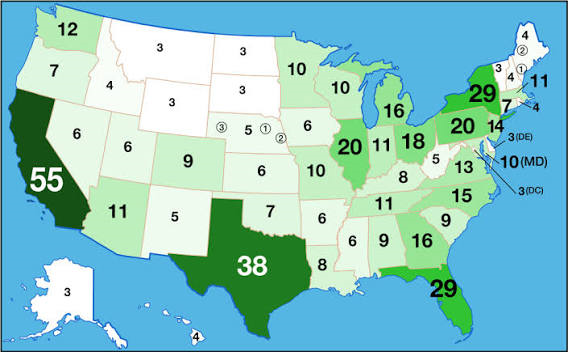
The Electoral College Map By State
Eventually the formula was devised. Each state would get two electoral votes and then more were added to every state depending on their population count. A required threshold was established to declare the winner based on accrued electoral votes.
There was also a fear of improper vote-counting over such a large and even then, diverse region. The Framers must have had an instinct into human nature.
So you have the history. Now lets present both well thought out positions for your consideration. We'll also add in a third hot topic that leads some, many in fact, to doubt when asked, "Is the Electoral College still necessary." We'll cover that in the wrap-up section of this page.
Is The Electoral College Still Necessary?
On the pro-side of the question, "Is the Electoral College still necessary," we offer up a few bullet points, followed by a call out box with part of a well-written affirmative case, which can be read in it's entirety here.
* Encourages candidates to build broad based support across larger sections of the country, rather than just concentrating on major population centers. The President will after all, be chief executive for the entire nation, not just the larger population centers.
* Assures that smaller states have a share in the decision on who will serve as President.
* Lessens the calamity of questionable vote counts. Rather than requiring a national recount, such potential problems are compartmentalized within individual states.
"The Electoral College prevents presidential candidates from winning an election by focusing solely on high-population urban centers and dense media markets, forcing them to seek the support of a larger cross-section of the American electorate. This addresses the Founders’ fears of a “tyranny of the majority,” which has the potential to marginalize sizeable portions of the population, particularly in rural and more remote areas of the country.
Large cities like New York City and Los Angeles should not get to unilaterally dictate policies that affect more rural states, like North Dakota and Indiana, which have very different needs. These states may be smaller, but their values still matter—they should have a say in who becomes President. By forcing presidential candidates to address all Americans during their campaigns, not just those in large cities, the Electoral College has the added benefit of eschewing radical candidates for more moderate ones..."
On the negative side, we'll present the same format. After the bullet points, you'll see a callout box with an excerpt from another excellent column which can be read within this link.
*Weakens legitimacy of the popular vote if a presidential candidate can win the most Electoral College votes and thereby the election while losing the total popular vote.
*Gives to much say in the presidential election to smaller states since every state gets at least three electoral votes. The mathematical theory is that this gives more weight per vote to smaller states.
*Leads candidates to spend the majority of resources and time on the handful of "swing states" while ignoring the states they feel are either safely in their corner or unwinnable. We'll address that swing state issue in the closing section.
"For years when I taught campaigns and elections at Brown University, I defended the Electoral College as an important part of American democracy. I said the founders created the institution to make sure that large states did not dominate small ones in presidential elections, that power between Congress and state legislatures was balanced, and that there would be checks and balances in the constitutional system.
In recent years, though, I have changed my view and concluded it is time to get rid of the Electoral College. In this paper, I explain the history of the Electoral College, why it no longer is a constructive force in American politics, and why it is time to move to the direct popular election of presidents. Several developments have led me to alter my opinion on this institution: income inequality, geographic disparities, and how discrepancies between the popular vote and Electoral College are likely to become more commonplace given economic and geographic inequities..."
Are We Focusing On The Problem or Chasing Symptoms?
There were definitely some good points in both arguments. But here in our editorial room, we wonder if this debate above whether or not the Electoral College is necessary anymore falls into the same category as the debate about expanding the Supreme Court?
Is it time to change those formats because they are no longer effective or because segments of the population, or more accurately the political agendas are not getting their way? Has compromise become too difficult? Or too illuminating of flawed ideals?
We recently posted a page about equality and equity. The Framers set aside their own personal whims, probably grudgingly in many cases, to find an equitable solution. We've seen instances in the past decade of both political machines while in power using their majority authority to weaponize parts of the federal government against those on the "other side."
Maybe the problem isn't the model of the Electoral College, but rather a low accountability bar for candidates? Maybe we're accepting unacceptable candidates? Maybe the problem is much more simple than changing systems. Maybe we need to be more personally and nationally responsible in who we nominate and for whom we settle?
As for the whole swing state argument, yes, it does tend to shift all focus to a handful of states. But population demographics change with age, opportunity, and national trends. A solid red or blue state can change quickly.
Tell us what you think. Is the Electoral College still necessary? Maybe it is, maybe not? Maybe the nation is crying out for a responsible adult who is a consensus builder? Maybe the system that was built to give the minority a voice, to force candidates to build a national rapport and trust is still viable?
Maybe we need to aim higher in who we run for the highest office in the land?
Have A Great Story Or Opinion About This Topic?
Do you have a great story or opinion about this? Share it!
Recent Articles


-
The Spirit Of 9-11. A Profile Of Courage, A Lesson In Citizenship.
Sep 14, 26 09:21 AM
History is essential for presenting facts, dispelling falsehoods, and guiding the future. Author T.O. Illustratio offers the importance of the spirit of 9-11. -
Understanding The Birthright Citizenship Debate Is A Listening Lesson
Sep 11, 26 02:19 PM
Understanding the birthright citizenship debate will require all the listening skills and clear thinking the adults in the room can muster. -
How To Be More Responsible. The Gateway To Accountability.
Sep 10, 26 08:02 AM
Follow this blueprint describing how to be more responsible as an accountable citizen and a visionary leader.
Something to Think About
"Avoid head trash. Don't be a garbage can for anything that does not feed your intellect, stimulate your imagination, or make you a more compassionate peaceful person. Refuse to open your mind to other people's trash. Tune out anything that promotes conflict or controversy. This can infect you with a mind virus of cynicism or defeat, and you won't even know it!."
Les Brown